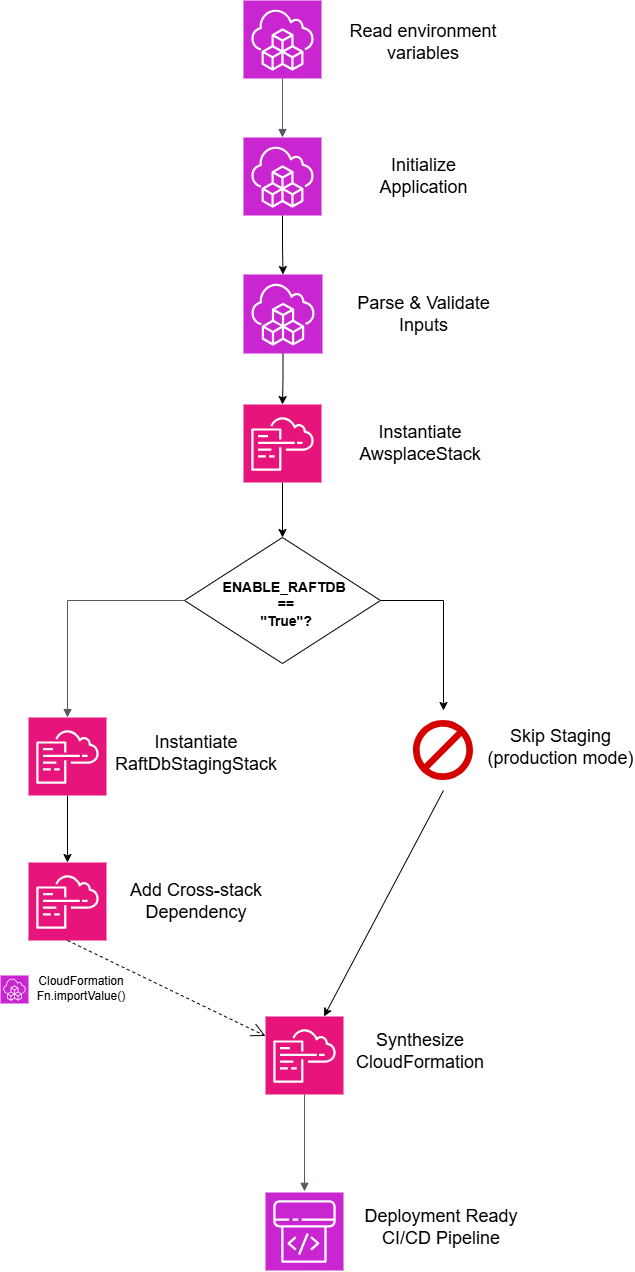
CDK Project Structure
The CDK (AWS Cloud Development Kit) code is where all the infrastructure for awsplace lives. We wrote it in TypeScript to take advantage of strict compiler checks. It sets up everything the app needs to run: networking, compute, databases, storage, authentication, DNS, and monitoring. We’ve split the setup across 15 TypeScript modules inside the cdk/ folder, all tied together by a single main stack that deploys out to the ap-southeast-1 (Singapore) region.
Here’s a breakdown of how the project structure is organized:
| Sub-section | Description |
|---|---|
| 5.4.1 Entry Point & Stack Composition | The main stack that links all the modules together in the right order (Includes: CDK App, AwsplaceStack, RaftDbStagingStack) |
| 5.4.2 VPC & Networking | Network setup using public subnets and no NAT Gateway to save costs (Includes: VPC, subnets, security groups) |
| 5.4.3 DynamoDB Database Layer | A simple single-table design using composite keys (Includes: 4 on-demand DynamoDB TableV2s) |
| 5.4.4 ECS Fargate Compute Layer | Where the Go app and RaftDB run behind an HTTPS load balancer (Includes: Fargate cluster, task definitions, ALB) |
| 5.4.5 Storage: ECR & S3 | Where we store Docker images and app files (Includes: ECR repository, 2 imported S3 buckets) |
| 5.4.6 IAM Roles & Security | Setting up least-privilege permissions for the containers and Lambda (Includes: 3 IAM roles) |
| 5.4.7 Lambda, API Gateway & Amplify | Serverless auth functions and frontend hosting (Includes: Lambda, HTTP API v2, Amplify app) |
| 5.4.8 RaftDB Infrastructure & Route 53 | DNS, certificates, and the RaftDB staging environment (Includes: Route 53, ACM cert, staging stack) |
CDK Philosophy
When writing the CDK code for awsplace, we stuck to a few core rules to keep things clean and easy to manage:
- Functions over classes: Instead of messy class inheritance, each module just exports a simple create()* function. It takes inputs and returns exactly what it built, making the code much easier to trace.
- Strict TypeScript: We turned on strict compiler checks (strict: true) to catch typos and missing config before you even run cdk synth.
- Export everything useful: We make sure to output things like table names, bucket names, and ARNs as CfnOutput so our CI/CD pipelines can easily grab them later.
- Importing S3 buckets: We don’t create S3 buckets directly in the stack. Instead, we import them by name. This way, if we ever tear down the stack with cdk destroy, we don’t accidentally delete our storage buckets.
- No hardcoded ARNs: We never construct raw ARN strings by hand. We always use CDK methods, which guarantees the ARNs will be correct no matter what account or region you deploy to.
- Protecting critical resources: We add RemovalPolicy.RETAIN to things we really don’t want to lose (like our ECR repo or secrets). A simple stack deletion won’t wipe out important data.