Entry Point & Stack Composition
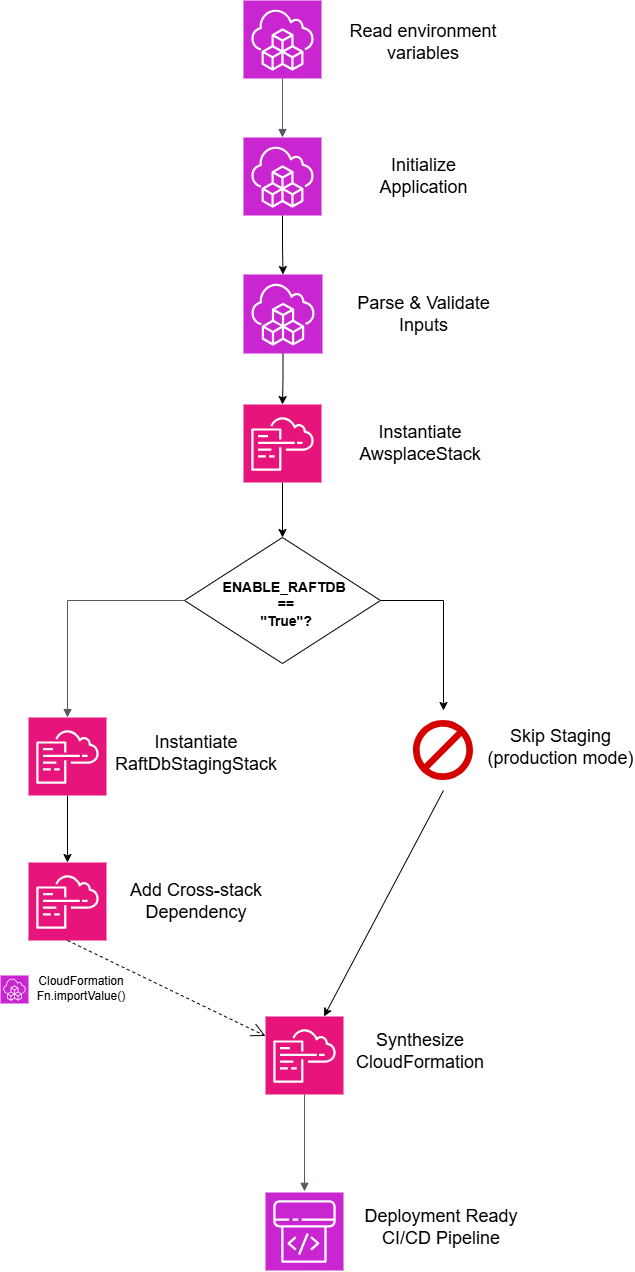
The CDK application begins at a single entry point file (bin/) that creates the CDK App, parses and validates environment variables for deployment configuration, instantiates the main AwsplaceStack, and conditionally adds a RaftDbStagingStack. This file is the bridge between CI/CD pipelines and the infrastructure code.
Entry point responsibilities
| Responsibility | Description |
|---|---|
| Environment configuration | Sets AWS account and region (default ap-southeast-1) |
| Input validation | 5 parsing functions validate deployment inputs before they reach any stack |
| Stack instantiation | Creates AwsplaceStack with validated props |
| Conditional staging | Creates RaftDbStagingStack only when ENABLE_RAFTDB=true |
| Cross-stack dependency | Staging stack depends on main stack (shared ECR repository) |
1. Entry Point Code
const app = new App();
const env = {
  account: process.env.CDK_DEFAULT_ACCOUNT,
  region: process.env.CDK_DEFAULT_REGION || 'ap-southeast-1',
};

const mainStack = new AwsplaceStack(app, 'AwsplaceStack', {
  env,
  domainName: process.env.DOMAIN_NAME || 'place.namanhishere.com',
  hostedZoneId: parseHostedZoneId(process.env.HOSTED_ZONE_ID),
  ecsImageTag: parseEcsImageTag(process.env.ECS_IMAGE_TAG),
  raftDbImageDigest: parseRaftDbImageDigest(process.env.RAFTDB_IMAGE_DIGEST),
});

if (process.env.ENABLE_RAFTDB === 'true') {
  const stagingStack = new RaftDbStagingStack(app, 'RaftDbStagingStack', {
    env,
    imageDigest: process.env.RAFTDB_IMAGE_DIGEST,
    dataGeneration: process.env.RAFTDB_DATA_GENERATION,
    restoreFromS3: parseRestoreFromS3(process.env.RAFTDB_RESTORE_FROM_S3),
    nodeCount: parseNodeCount(process.env.RAFTDB_NODE_COUNT),
  });
  stagingStack.addDependency(mainStack,
    'RaftDB staging imports the shared ECR repository');
}

app.synth();
2. Input Validation Functions
Five parsing functions guard the boundary between the outside world (environment variables set by CI/CD) and the CDK internals. Each validates format and provides a deterministic fallback for credential-free synthesis.
a) parseHostedZoneId()
function parseHostedZoneId(raw: string | undefined): string {
  if (!raw) {
    // Deterministic placeholder for credential-free synthesis
    return 'ZPLACEHOLDERPLACEHOLDER';
  }
  if (!/^Z[A-Z0-9]+$/.test(raw)) {
    throw new Error(
      'HOSTED_ZONE_ID must be a Route 53 hosted zone ID (starts with Z, alphanumeric)'
    );
  }
  return raw;
}
This validates the Route 53 hosted zone ID format (Z followed by alphanumeric characters). If absent (e.g., during local development or test synthesis), it returns a deterministic placeholder so cdk synth can run without real AWS credentials.
b) parseEcsImageTag()
function parseEcsImageTag(raw: string | undefined): string {
  if (!raw) {
    return 'latest';
  }
  if (!/^[\w][\w.-]{0,127}$/.test(raw)) {
    throw new Error(
      'ECS_IMAGE_TAG must be a valid Docker image tag ' +
      '(max 128 chars, alphanumeric, periods, underscores, hyphens)'
    );
  }
  return raw;
}
Validates Docker image tag format per the OCI specification. The CI/CD pipeline sets this to the Git commit SHA — e.g., ECS_IMAGE_TAG=abc123def456. The deployment contract tests verify that invalid tags (like invalid/tag) cause synthesis to fail fast.
c) parseRaftDbImageDigest()
function parseRaftDbImageDigest(raw: string | undefined): string {
  if (!raw) {
    return 'sha256:ffffffffffffffffffffffffffffffffffffffffffffffffffffffffffffffff';
  }
  if (!/^sha256:[a-f0-9]{64}$/.test(raw)) {
    throw new Error(
      'RAFTDB_IMAGE_DIGEST must be a SHA256 digest (sha256:<64 hex chars>)'
    );
  }
  return raw;
}
RaftDB images are always referenced by immutable SHA256 digest, never a mutable tag. This function enforces the format sha256:<64 hex characters>. The all-f placeholder digest is intentionally invalid for real ECR pulls — it only exists so cdk synth completes without credentials.
d) parseNodeCount()
function parseNodeCount(raw: string | undefined): number {
  const n = Number(raw ?? '1');
  if (n !== 1 && n !== 3) {
    throw new Error('RAFTDB_NODE_COUNT must be 1 or 3');
  }
  return n;
}
RaftDB only supports 1-node (qualification) or 3-node (full Raft consensus) deployments. Any other value is rejected.
e) parseRestoreFromS3()
function parseRestoreFromS3(raw: string | undefined): boolean {
  if (!raw) return false;
  if (raw === 'true') return true;
  if (raw === 'false') return false;
  throw new Error('RAFTDB_RESTORE_FROM_S3 must be "true" or "false"');
}
Enforces strict boolean parsing — no truthy/falsy ambiguity.
Validation summary
| Function | Accepts | Rejects | Placeholder for synth |
|---|---|---|---|
| parseHostedZoneId | Z[A-Z0-9]+ | Missing, wrong prefix | ZPLACEHOLDERPLACEHOLDER |
| parseEcsImageTag | [\w][\w.-]{0,127} | Slashes, 129+ chars | latest |
| parseRaftDbImageDigest | sha256:[a-f0-9]{64} | Wrong length, non-hex | sha256:ffff…ffff |
| parseNodeCount | 1, 3 | 2, 0, non-numeric | 1 |
| parseRestoreFromS3 | “true”, “false” | “yes”, "", missing | false |
3. AwsplaceStack — The Main Orchestrator
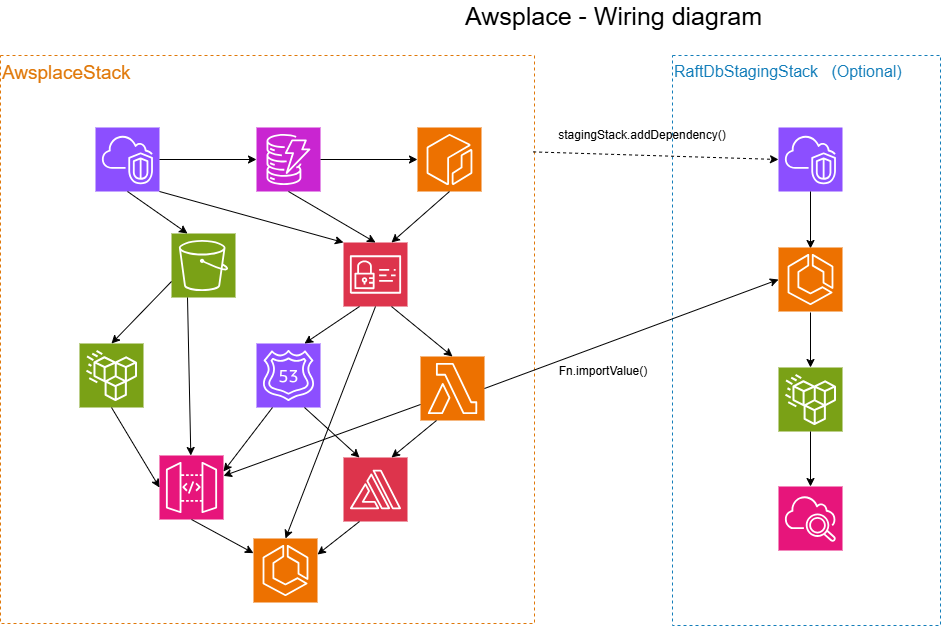
The AwsplaceStack class extends the CDK Stack class and wires together all infrastructure modules in a specific dependency order.
Constructor props
| Property | Type | Source | Example |
|---|---|---|---|
| domainName | string | DOMAIN_NAME env var | place.namanhishere.com |
| hostedZoneId | string | HOSTED_ZONE_ID env var (parsed) | Z1234567890ABC |
| ecsImageTag | string | ECS_IMAGE_TAG env var (parsed) | abc123def456 (commit SHA) |
| raftDbImageDigest | string | RAFTDB_IMAGE_DIGEST env var (parsed) | sha256:abcd…1234 |
Resource creation order
The constructor calls modules in this exact sequence:
 1. createVpc(this)                        → VpcOutput
 2. createDatabase(this)                   → DatabaseOutput
 3. createEcr(this)                        → EcrOutput
 4. createStorage(this, ...)               → StorageOutput
 5. createIamRoles(this, ...)              → IamOutput
 6. createRaftDbApplicationStorage(...)    → RaftDbAppStorage
 7. createRoute53AndCertificates(...)       → Route53AndCertOutput
 8. createLambda(this, ...)                → LambdaOutput
 9. createApiGateway(this, ...)            → ApiGatewayOutput
10. createAmplify(this, ...)               → AmplifyOutput
11. createEcs(this, ...)                   → EcsOutput
Why this order matters:
- VPC first — every network-attached resource needs subnet and AZ information.
- Database and storage before IAM — IAM policies need table ARNs and bucket ARNs to scope permissions.
- IAM before Lambda and ECS — both need their execution/task roles to exist at creation time.
- Route 53 before API Gateway, Amplify, and ECS — the wildcard ACM certificate must exist before any TLS-enabled resource references it.
- ECS last — it references VPC, IAM, ECR, database, storage, secrets, EFS, and Route 53. Creating it last ensures all dependencies are available.
CloudFormation Outputs
The stack emits 21 CloudFormation outputs so CI/CD pipelines and operational scripts can reference infrastructure values without hardcoding:
| Output | Value | Consumers |
|---|---|---|
| VpcId | VPC ID | Operational scripts, dashboard |
| EcsRepositoryUri | ECR repository URI | scripts/push-ecs-image.sh |
| EcsRepositoryName | ECR repository name | Cross-stack import (staging stack), CI/CD |
| EcsClusterName | ECS cluster name | aws ecs wait services-stable |
| EcsServiceName | ECS service name | aws ecs wait services-stable |
| EcsTaskExecutionRoleArn | ECS execution role ARN | Operational reference |
| EcsTaskRoleArn | ECS task role ARN | Operational reference |
| LambdaExecutionRoleArn | Lambda execution role ARN | Operational reference |
| ApiFunctionArn | Lambda function ARN | CI/CD verification |
| AppSecretArn | Secrets Manager secret ARN | Rotation scripts |
| ConfigTableName | Config DynamoDB table name | Admin tools |
| BansTableName | Bans DynamoDB table name | Admin tools |
| MilestonesTableName | Milestones DynamoDB table name | Scheduler verification |
| HistoryTableName | History DynamoDB table name | Data export scripts |
| CanvasBucketName | Canvas S3 bucket name | Export scripts |
| ExportsBucketName | Exports S3 bucket name | Admin dashboard |
| RaftDbFileSystemId | RaftDB EFS filesystem ID | Recovery procedures |
| RaftDbSnapshotBucketName | RaftDB snapshot S3 bucket | Snapshot management |
| AmplifyAppId | Amplify application ID | scripts/deploy-frontend.sh |
| AmplifyDefaultDomain | Amplify default domain | Verification |
| AmplifyBranchName | Amplify production branch name | Verification |
Cross-stack reference
The ECR repository name is exported so the staging stack can import it via Fn.importValue():
// In AwsplaceStack:
new CfnOutput(this, 'EcsRepositoryName', {
  value: ecrRepo.repositoryName,
  exportName: 'AwsplaceEcsRepositoryName',
});

// In RaftDbStagingStack:
const repository = ecr.Repository.fromRepositoryName(
  this, 'SharedEcrRepository',
  Fn.importValue('AwsplaceEcsRepositoryName')
);
This is the mechanism that allows two separate CloudFormation stacks to share a single ECR repository — the staging stack pulls the same RaftDB images that the production stack uses.
4. RaftDbStagingStack — Conditional Second Stack
When ENABLE_RAFTDB=true, a second CloudFormation stack is created for RaftDB qualification and recovery drills. This stack is never used in production — the production RaftDB runs as a sidecar in the main ECS task.
if (process.env.ENABLE_RAFTDB === 'true') {
  const stagingStack = new RaftDbStagingStack(app, 'RaftDbStagingStack', {
    env,
    imageDigest: process.env.RAFTDB_IMAGE_DIGEST,
    dataGeneration: process.env.RAFTDB_DATA_GENERATION,
    restoreFromS3: parseRestoreFromS3(process.env.RAFTDB_RESTORE_FROM_S3),
    nodeCount: parseNodeCount(process.env.RAFTDB_NODE_COUNT),
  });
  stagingStack.addDependency(mainStack,
    'RaftDB staging imports the shared ECR repository');
}
The addDependency call ensures the main stack is deployed before the staging stack — the staging stack cannot resolve Fn.importValue(‘AwsplaceEcsRepositoryName’) until the main stack exists.